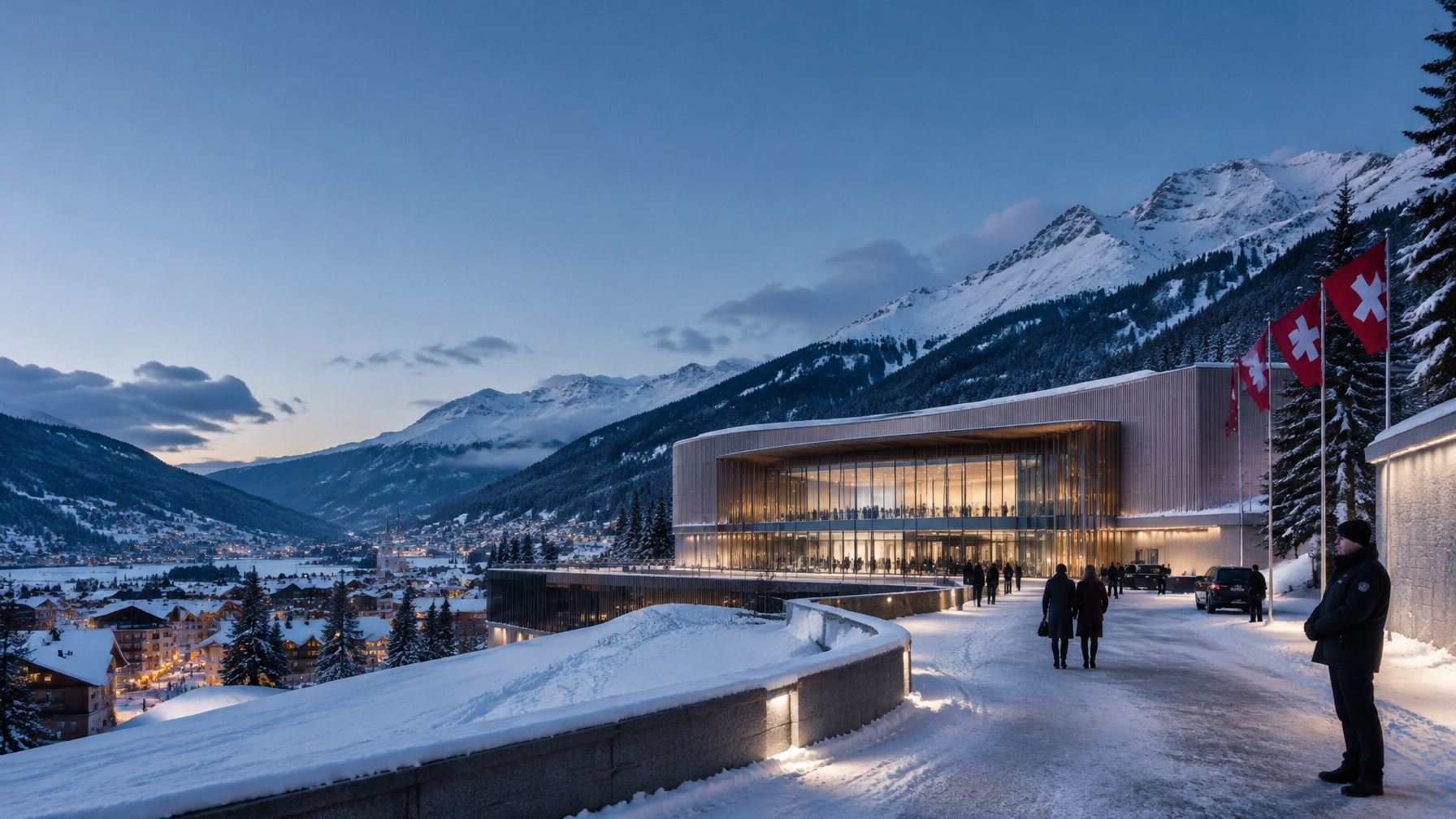
Davos 2027 Networking Guide: Where Founders, Investors and CEOs Actually Meet
By The Davos Collective · 16 September 2026 · 9 min read

Davos 2027 networking will operate across two connected but distinct systems: the official World Economic Forum Annual Meeting and the broader ecosystem of houses, receptions, roundtables, hotels and private meetings around it.
For founders, investors, family offices and CEOs, the highest-value conversations usually depend less on badge status than on preparation, relevance, introductions and disciplined movement through the week.
Davos 2027 dates and the networking landscape
The World Economic Forum Annual Meeting 2027 is scheduled for 18–22 January 2027 in Davos-Klosters, Switzerland. The official meeting will be centred at the Davos Congress Centre, with approximately 3,000 participants from business, government, international organisations, academia, civil society, media and the arts.
These are the central WEF 2027 dates. They are not a complete calendar of activity in Davos.
During the same week, the town will host:
- National houses and country pavilions
- Corporate houses and client programmes
- Investor breakfasts and family office meetings
- Technology, AI, climate and healthcare gatherings
- Private dinners and receptions
- Media lounges and research briefings
- Founder roundtables and pitch events
- Informal meetings in hotels, restaurants and cafés
The official programme is controlled by the World Economic Forum. The surrounding Davos 2027 events ecosystem is organised by companies, governments, associations, investors, media organisations and independent event producers.
That distinction determines how access is secured.
Where founders, investors and CEOs actually meet
1. National houses and country pavilions
National houses function as temporary platforms for diplomatic, commercial and investment networks. They often combine policy discussions with business meetings, receptions and cultural programming.
They are particularly relevant for:
- Cross-border investors
- Export-oriented companies
- Founders entering new markets
- Government relations advisers
- Corporate development teams
- Members of national business delegations
The Davos houses 2027 landscape will become clearer through the final quarter of 2026. Access will vary by house. Some sessions may be open with registration; others will depend on invitations, delegation status or introductions.
The most effective approach is specific outreach to the relevant delegation, trade office, commercial attaché or programme organiser. A clear reason for attendance is more useful than a general request for access.
2. Corporate houses
Corporate houses attract clients, partners, executives, policymakers and industry specialists. Their value is usually concentrated in small meetings rather than headline panels.
Corporate programmes are most useful when the objective involves:
- Enterprise sales
- Strategic partnerships
- Technology adoption
- M&A conversations
- Public-private initiatives
- Sector-specific intelligence
Founders should identify the regional or sector leaders hosting the programme. Communications teams manage visibility; senior partners and executives often control the more valuable guest introductions.
3. Sector and innovation houses
Sector-focused venues provide higher-density access to relevant people than general receptions. For example, an AI founder will usually find greater value in a focused artificial intelligence house than in a broad celebrity-led gathering.
Priority categories for 2027 are likely to include:
- Artificial intelligence and data infrastructure
- Climate technology and energy transition
- Digital assets and fintech
- Healthcare and life sciences
- Industrial technology
- Cybersecurity
- Sustainable finance
- Geopolitics and global trade
These venues create better conditions for substantive conversations because participants share a defined subject, vocabulary and set of commercial interests.

4. Hotels, restaurants and meeting lounges
Hotels remain central to Davos networking because they provide controlled spaces for breakfasts, bilateral meetings, investor briefings and evening receptions.
The most productive meetings often happen:
- Before the main programme begins
- Between two scheduled sessions
- Immediately after a relevant panel
- At a small dinner
- In a hotel lobby between appointments
- During travel between venues
The official Davos Congress Centre information notes that Zurich is approximately two hours from Davos by road. Once in town, walking time and weather should be treated as part of the schedule. A meeting that appears geographically close may still require a meaningful buffer in January conditions.
Who is attending Davos 2027?
The question “Who is attending Davos 2027?” is more useful when divided into specific target groups.
Target group Where they are most likely to gather Best meeting objective
Venture capital investors Innovation houses, founder dinners, investor breakfasts Fundraising and market intelligence
Family offices Private dinners, hotel lounges, curated roundtables Direct investment and co-investment
CEOs and corporate executives Corporate houses, client programmes, bilateral meetings Partnerships and enterprise opportunities
Government and policy leaders National houses, official sessions, policy briefings Regulation and public-sector access
Advisors and consultants Corporate venues, receptions, sector panels Introductions and strategic collaboration
Technology founders AI, fintech, climate and innovation houses Capital, customers and distribution
A public Davos attendee list 2027 should not be treated as a complete networking database. Official participation lists, where published, typically cover only specific categories of participants. Side-event guest lists are usually fragmented, private or released close to the event.
A more reliable method is to build a target map from:
- Confirmed speakers
- House hosts and partners
- Previous-year participants
- Investor portfolio companies
- National delegation announcements
- Relevant LinkedIn and event-platform activity
- Warm introductions from trusted contacts
How to plan your Davos networking strategy
Define one measurable outcome
A week in Davos can produce hundreds of conversations and no useful result without a defined objective.
Examples:
- Five meetings with Series B investors
- Three family office conversations
- Two enterprise pilot discussions
- One strategic distribution partnership
- Ten policy meetings in a defined market
- A qualified list of potential acquisition targets
The objective determines which events to accept and which to decline.
Build a priority list
Use three tiers:
Tier 1: Essential meetings People whose participation directly affects fundraising, investment, policy or commercial outcomes.
Tier 2: High-value opportunities People with relevant networks, sector expertise or potential future influence.
Tier 3: Exploratory contacts People who may provide intelligence, referrals or unexpected opportunities.
Limit Tier 1 to approximately 10–15 people. A schedule built around 40 “essential” meetings is not operationally credible.
Start outreach early
A practical timeline:
- September–October 2026: define objectives, identify houses and map target contacts
- October–November: request introductions, monitor event announcements and submit speaking applications
- November–December: confirm meetings, register for priority events and finalise accommodation
- January 2027: reconfirm every meeting, group appointments geographically and preserve open time
The best outreach is concise. State the relevant issue, the reason for the meeting and the proposed time window. Avoid sending a company biography before the recipient has agreed to engage.
Davos networking events: access without an official badge
“How to attend Davos without a WEF badge” is one of the most important practical questions for founders and investors.
The answer is straightforward: access the parallel ecosystem rather than attempting to replicate official participation.
Possible routes include:
- Registration for open or RSVP-based side events
- Invitations from national or corporate houses
- Speaking or moderating opportunities
- Curated investor and executive programmes
- Introductions through portfolio companies or advisers
- Meetings in public hotels, restaurants and cafés
- Participation in relevant fringe conferences
Davos event registration should be completed as soon as credible programmes are published. Registration does not guarantee entry where capacity, security or invitation requirements apply. Each organiser sets its own access rules.
A hotel or security credential may support movement through designated zones, but it is not equivalent to an official WEF Annual Meeting badge and does not automatically provide entry to private events.
A practical daily operating model
A productive Davos schedule should contain three layers:
Time Primary use
07:30–10:00 Investor breakfasts, bilateral meetings and preparation
10:00–17:00 Houses, panels, roundtables and targeted meetings
17:00–21:00 Receptions, introductions and private dinners
After 21:00 Selective relationship-building, not indiscriminate event-hopping
Leave at least 30 minutes between meetings. Walking, queues, security and weather can disrupt an otherwise efficient calendar.
The Promenade is a useful connector, not a guaranteed networking venue. Conversations there are more effective when they follow an existing introduction or shared event.

How to create useful conversations
A strong opening is contextual rather than promotional.
Useful approaches include:
- “What has changed in your investment view since last year?”
- “Which part of the AI infrastructure market is still mispriced?”
- “What would make this partnership commercially viable in 2027?”
- “Which regulatory development is affecting your allocation decisions?”
- “Which conversation are you trying to have in Davos that is not on the formal agenda?”
Avoid beginning with a full pitch. Establish relevance first, then determine whether a deeper discussion is warranted.
For Davos investors 2027, the quality of the question is often a stronger signal than the length of the presentation. For CEOs, brevity and commercial clarity matter more than a broad description of the company.
Turning conversations into Davos deal opportunities
Record three details after every important meeting:
- The issue discussed
- The person’s stated priority
- The agreed next step
Follow up within 48 hours. The message should refer to the actual conversation and contain one clear action: a call, a document, an introduction or a meeting.
The most valuable Davos deal opportunities rarely close during the week itself. Davos compresses introductions; diligence, trust and execution follow later.

Frequently asked questions
Is Davos 2027 open to people without a WEF badge?
Yes. Many side events, houses, receptions and private meetings operate outside the official Congress Centre. Access depends on registration, invitation, capacity and the organiser’s security arrangements.
When should founders begin arranging Davos meetings?
Planning should begin at least three to four months before the Annual Meeting. Earlier preparation is advisable for accommodation, speaking opportunities, national houses and high-demand investor meetings.
How can I find relevant Davos side events 2027?
Monitor official event pages, organiser websites, credible listings and direct communications from houses. Prioritise events that match a defined sector, investor category or commercial objective.
Where should I stay during WEF week?
Davos accommodation and venues should be selected around the location of confirmed meetings, not only price or prestige. Hotels near the Promenade, Congress Centre and major meeting zones reduce daily travel friction, but availability is limited and rates rise sharply during the week.
Conclusion
Davos 2027 networking will reward preparation, relevance and selectivity across the official meeting and the wider side-event ecosystem. The Davos Collective provides independent intelligence on the networks, conversations and decision-makers shaping this environment and is not affiliated with the World Economic Forum.