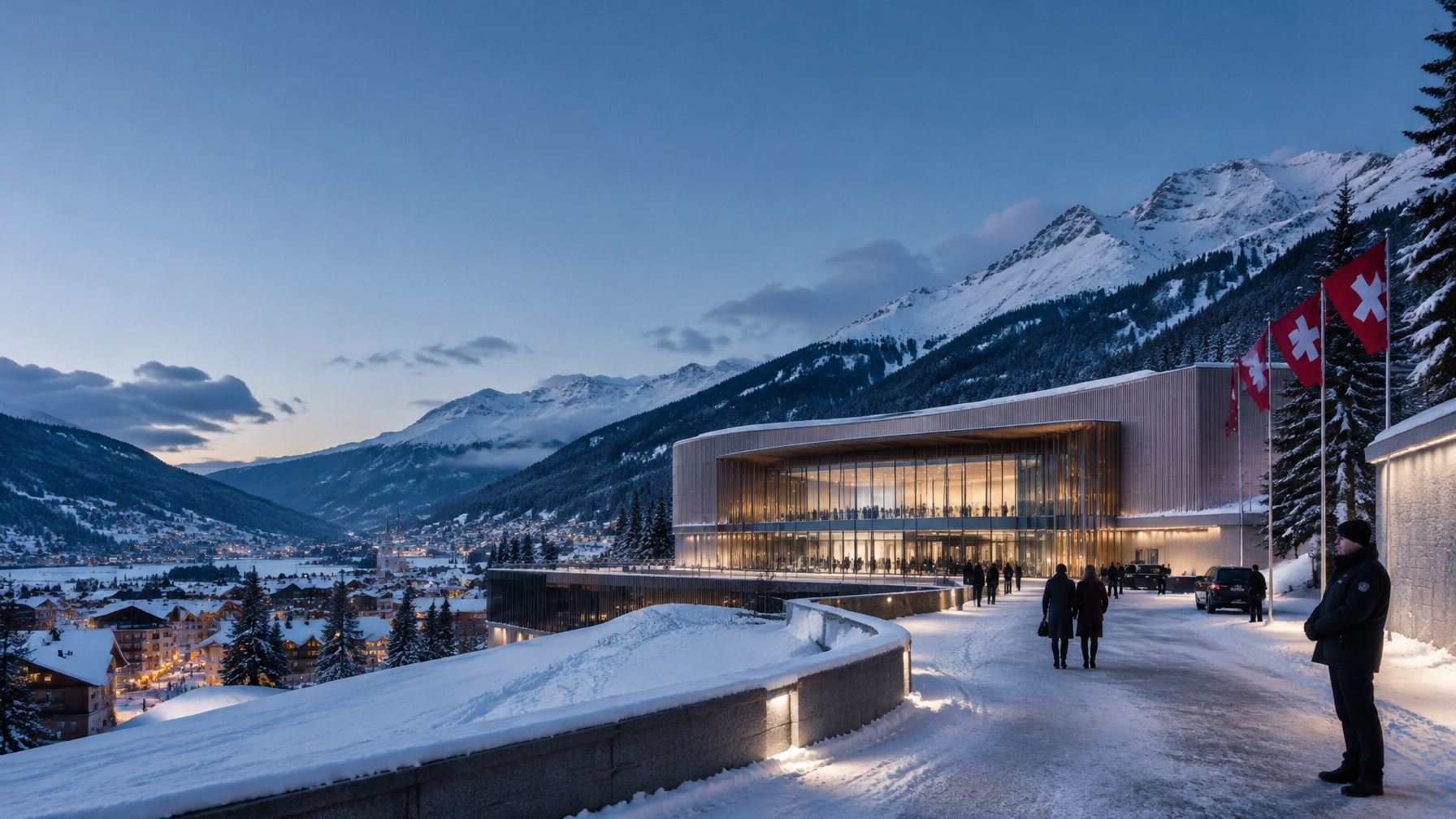
Davos Side Events 2027: Where the Real Conversations Happen
By The Davos Collective · 14 September 2026 · 9 min read

The official programme of the World Economic Forum attracts the headlines. The most consequential conversations often take place elsewhere: in hotel suites, private chalets, branded houses, investor breakfasts, partner summits and closed-door dinners distributed across Davos.
For executives, investors and policy professionals, understanding Davos side events 2027 is not a matter of collecting invitations. It is a matter of identifying which gatherings align with capital, policy influence, sector priorities and decision-making authority.
The World Economic Forum Annual Meeting 2027 is scheduled for 18–22 January 2027 in Davos-Klosters, with the official programme centred on the Davos Congress Centre. Around it sits a parallel ecosystem with its own hosts, access rules, commercial objectives and informal networks.
What are Davos side events?
“Davos side events” is a broad term covering programming held outside the official WEF agenda. It includes:
- Partner summits and institutional forums
- Branded houses along the Promenade
- Investor breakfasts and capital roundtables
- Corporate receptions and private dinners
- Media-house panels and editorial salons
- Technology, climate and policy gatherings
- Bilateral meetings hosted in hotels, chalets and restaurants
- Open-registration sessions and public-facing discussions
These events are not a single programme. Each host controls its own guest list, registration process, agenda and commercial purpose.
Some gatherings are designed for visibility and media reach. Others are structured around introductions, fundraising, policy alignment or deal formation. The distinction matters. A prominent panel may produce limited access to decision-makers, while a smaller breakfast can generate a more relevant conversation.

Official WEF programming versus Parallel Davos
The official World Economic Forum programme is concentrated around the Congress Centre and requires WEF accreditation. Its sessions, meetings and controlled access arrangements are managed by the Forum.
The wider ecosystem operates differently. Parallel Davos includes houses, hotels, private venues and satellite programmes operating alongside the Annual Meeting. Most do not require a WEF badge, although access may still depend on:
- A direct invitation
- Host approval
- Reviewed registration
- A referral from an existing participant
- A commercial partnership
- Capacity at the venue
- A specific role, sector or seniority
A WEF badge therefore does not provide universal access to the side-event ecosystem. Conversely, attending Davos without a WEF badge remains possible when the objective is focused on external programming rather than the official Congress Centre agenda.
The distinction should be treated precisely. “No badge required” does not mean “open access.”
The main categories of Davos side events 2027
1. Davos houses
The Davos houses 2027 landscape will likely include corporate, national, sectoral, media and technology-focused venues. These temporary or semi-permanent spaces typically host:
- Public panels
- Invite-only roundtables
- Broadcasts and interviews
- Investor meetings
- Networking receptions
- Product and policy showcases
The Promenade remains the central geography for many visible houses. However, a house’s location is not an indicator of access. Some operate as public-facing platforms; others are effectively private meeting hubs with limited guest lists.
The most useful question is not which house is most visible. It is which house convenes the people relevant to a particular mandate.
2. Partner summits
Partner summits tend to be more structured than informal networking events. They may focus on a defined theme such as artificial intelligence, climate finance, healthcare, geopolitics, digital assets or emerging-market investment.
Their value often lies in concentrated participation. A well-designed summit can place corporate leaders, policymakers, investors and researchers in the same room for several hours rather than offering a short panel followed by general networking.
Partner status should not be confused with official WEF affiliation. A programme taking place during WEF week may be independently hosted, commercially organised or supported by a separate institution.
3. Investor events
Davos investors 2027 programming is likely to include breakfasts, private capital meetings, sovereign wealth discussions, family-office gatherings and institutional roundtables.
These events are often less visible online than public panels. Invitations may be managed through:
- Investment banks
- Venture capital and private-equity networks
- Family offices
- Sovereign institutions
- Corporate strategy teams
- Specialist event organisers
- Existing participant referrals
The relevant signal is usually not the number of attendees. It is the quality of the capital conversation: mandate, ticket size, sector interest, investment horizon and decision-making authority.
4. Media and editorial programming
Media houses provide a high-visibility layer of Parallel Davos. Their formats can include live broadcasts, interviews, editorial salons and policy panels.
Access varies substantially. Some sessions are open to registered participants, while others are reserved for invited executives, speakers, advertisers, institutional partners or contributors.
For companies seeking visibility, media events may be useful. For investors and policy professionals, their value depends on whether the programme creates access beyond the stage.
5. Closed dinners and private meetings
The most difficult events to discover are often the most targeted. Private dinners, hotel-suite meetings and chalet roundtables may never appear in a public event directory.
They are typically assembled around a defined purpose:
- A prospective investment
- A government or regulatory discussion
- A strategic partnership
- A board-level relationship
- A market-entry conversation
- A financing or transaction opportunity
These formats reward relevance rather than volume. A concise, credible reason for participation is generally more effective than broad outreach to every organiser in Davos.

How to find and evaluate Davos side events
Public listings will become more complete as January 2027 approaches. Useful starting points include:
- The Davos municipality’s official WEF 2027 listing
- iDavos event and guide listings
- Davos Access side-event directories
- Davos Access Side Stage
- Host organisations’ own registration pages
- Sector-specific event newsletters and invitations
Each listing should be assessed against five criteria:
Criterion Question
Purpose Is the event designed for discussion, visibility, recruitment or transactions?
Participants Are the relevant decision-makers identified, or is attendance described vaguely?
Access Is registration open, reviewed, invite-only or referral-based?
Format Does it provide time for substantive interaction?
Venue Is the location confirmed, practical and appropriate for the intended meeting?
Schedules can change. Event names, times, speakers and access requirements may remain provisional until close to the Annual Meeting. A listing is an indication of intent, not a guaranteed programme.
Registration and access without a WEF badge
For most independent side events, the process begins with the host rather than the World Economic Forum.
A practical registration sequence is:
- Identify relevant houses, summits and private formats.
- Confirm the host, venue and access category.
- Register through the official event page or contact the organiser.
- Provide role, organisation, sector and reason for participation where requested.
- Wait for approval rather than assuming an RSVP is a confirmed place.
- Reconfirm venue and timing shortly before arrival.
Some programmes permit open registration. Others review each application. High-level investor and policy gatherings may require a personal introduction or invitation several months ahead.
A badge-free attendance plan should also allow for movement between venues. Davos events are geographically concentrated but schedules overlap, winter conditions affect travel time and access checks can create delays.
A planning timetable for Davos 2027
September–October 2026
Define objectives, sectors and priority relationships. Begin reviewing Davos side events 2027, partner summits and the emerging Davos houses 2027 calendar.
This is also the period to identify accommodation and venue requirements. Demand is concentrated, and late planning limits both choice and flexibility.
November–December 2026
Move from discovery to qualification. Confirm which events are genuinely relevant, which require introductions and which provide credible access to investors, policymakers or operating partners.
Begin arranging bilateral meetings separately from public programming. Side events should support a meeting strategy, not replace it.
January 2027
Reconfirm every registration, invitation and venue. Public schedules are likely to change. Build a daily plan with geographic clusters and sufficient space between meetings.
The strongest programme is usually selective. A smaller number of relevant conversations creates more value than an overloaded calendar of disconnected events.

What executives and investors should watch
The commercial significance of Davos side events lies in the network around the event, not only in the sessions themselves.
Watch for:
- Repeated participation by the same institutional actors
- New coalitions forming around a policy or technology theme
- Investor activity around emerging sectors
- National delegations using external venues for commercial outreach
- Corporate houses convening customers, regulators and capital providers
- Announcements that follow private meetings rather than public panels
- Shifts in language from commitments to financing, implementation and execution
This is where attendee intelligence becomes more important than event volume. A public Davos attendee list 2027 will never capture the full ecosystem, particularly where invitations, private meetings and informal networks determine access.
The challenge is separating genuine influence from event visibility. A heavily promoted gathering may have limited decision-making power. A small private meeting may signal a more consequential alignment.
An independent view of Parallel Davos
The Davos ecosystem includes the official World Economic Forum programme and a much larger surrounding network of organisations, businesses, investors, media groups, governments and policy actors.
The Davos Collective is not affiliated with the World Economic Forum. That independence permits analysis of the ecosystem without institutional alignment: its networks, conversations, participants, access structures and emerging signals.
For anyone evaluating Davos side events 2027, the essential distinction is clear. The official agenda shows what is formally presented. Parallel Davos shows where relationships are formed, priorities are tested and opportunities begin to take shape.
The two layers are connected, but they are not the same.
Frequently asked questions
When are the WEF 2027 dates?
The World Economic Forum Annual Meeting 2027 is scheduled for 18–22 January 2027 in Davos-Klosters. Confirm dates and venue information through the official Davos listing.
Can I attend Davos side events without a WEF badge?
Yes, many side events do not require a WEF badge. Access may still depend on invitation, registration, host approval, referral or venue capacity.
When should I register for Davos side events 2027?
Begin identifying events and contacting organisers several months in advance. Invite-only dinners, investor meetings and high-demand houses may close their guest lists before the Annual Meeting.
Are Davos houses officially part of the World Economic Forum?
Not necessarily. Many houses and satellite venues are independently hosted. Their timing and location during WEF week do not establish affiliation with the World Economic Forum.
Where do Davos side events take place?
Common venues include the Promenade, hotels, private chalets, restaurants, meeting rooms and temporary houses across Davos. The host’s confirmed registration information should take precedence over third-party listings.
What is the difference between a side event and a partner summit?
A side event is a broad category covering external programming during the Annual Meeting. A partner summit is generally a more structured, themed programme hosted by an organisation or group of organisations.
How can investors identify the most relevant Davos events?
Assess the host, participant profile, stated purpose, access model, format and evidence of substantive capital participation. Visibility alone is not a reliable indicator of investment relevance.
What should I do if event information changes?
Reconfirm registration, venue, timing and access requirements shortly before travel. Davos programming develops continuously, and provisional listings may be updated as hosts finalise their plans.