Who Attends Davos? A Look Inside the Global Decision-Makers Network
By The Davos Collective · 15 September 2026 · 8 min read
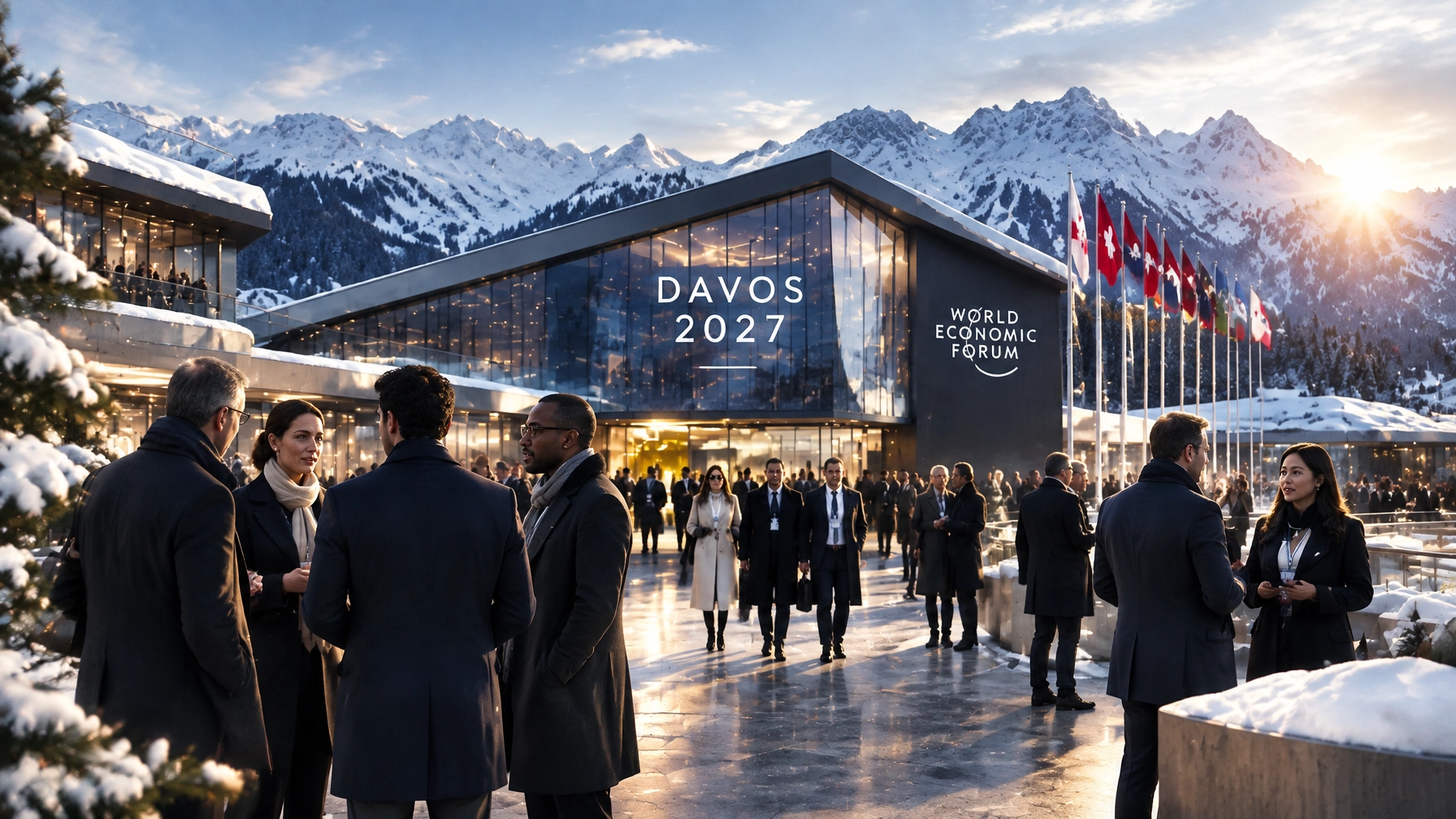
Davos is often described as a meeting of the world’s most influential people. That description is accurate but incomplete. The annual gathering in Davos-Klosters is not one room, one audience or one access list. It is a layered ecosystem in which official participants, private-sector delegations, government leaders, investors, advisers, media organisations and unaffiliated visitors operate across overlapping networks.
Understanding who attends Davos requires separating the official World Economic Forum Annual Meeting from the broader activity that takes place across the town during the same week.
The official meeting is invitation-only. The wider Davos ecosystem is larger, more fluid and more difficult to map.
Who attends the official Davos meeting?
The World Economic Forum’s 2026 Annual Meeting brought together close to 3,000 participants from approximately 130 countries. The official breakdown included around 400 senior political leaders, including nearly 65 heads of state and government, as well as approximately 1,700 business leaders.
The participant base also included academics, civil society leaders, international organisations, technology founders, media representatives and cultural figures. This composition gives Davos its distinctive cross-sector character: the meeting is not limited to corporate executives or political leaders, but creates structured proximity between groups that rarely share the same institutional setting.
Business executives
Corporate leaders form the largest and most commercially significant group at Davos. The official 2026 figures included close to 850 CEOs and chairpersons from Forum member and partner companies.
These executives generally represent:
- Multinational corporations
- Banks, insurers and asset managers
- Energy and industrial companies
- Technology and platform businesses
- Pharmaceutical and healthcare groups
- Consumer and infrastructure companies
- High-growth technology firms and unicorns
Their objectives vary. Some are pursuing policy dialogue, market intelligence or geopolitical assessment. Others are meeting investors, regulators, potential partners or prospective clients. For many, Davos is also an opportunity to test how their company is perceived among policymakers, competitors and influential intermediaries.
The important distinction is that corporate presence does not automatically indicate equal influence. A chief executive with a clear policy objective, strong relationships and access to relevant private meetings may have a greater impact than a larger delegation with a higher public profile.
Political leaders and policy professionals
Davos attracts presidents, prime ministers, ministers, central bank governors, senior civil servants and advisers from major economies. Finance, foreign affairs, trade, industry and technology ministries are particularly visible because many discussions concern investment, regulation, security and economic policy.
Political attendance serves several functions:
- Signalling national priorities
- Meeting business leaders and investors
- Advancing bilateral diplomacy
- Reassuring markets
- Building coalitions around international initiatives
- Testing reactions to policy proposals
For policy professionals, the value of Davos often lies outside the headline plenaries. Briefings, bilateral meetings and smaller working sessions provide access to business intelligence that may not appear in formal speeches.
Political visibility can be significant, but public prominence is not the same as decision-making authority. A minister may attract media attention while a senior adviser, negotiator or regulator shapes the language that later appears in an agreement.
Investors and financial institutions
Investors attend Davos to assess risk, identify capital opportunities and interpret the direction of policy. The group includes private-equity executives, sovereign wealth funds, pension funds, venture capital investors, hedge funds, family offices, bank leaders and institutional allocators.
Their focus typically includes:
- Macroeconomic conditions
- Interest rates and capital availability
- Geopolitical risk
- Energy and infrastructure
- Artificial intelligence and technology
- Emerging-market exposure
- Regulatory change
- Long-term industrial policy
Investors often operate as connectors between companies, governments and sources of capital. Their influence is rarely visible through formal participation alone. It emerges through private assessments, introductions and the ability to move capital after the event.
The wider Davos ecosystem
The official Annual Meeting is only one layer. During Davos week, the town hosts a much broader network of events, private houses, corporate venues, receptions, media studios, investor gatherings and public discussions.

This wider ecosystem includes people who may never enter the Congress Centre but still participate in consequential conversations.
Consultants and advisers
Consultants, law firms, public-affairs specialists, economists, executive advisers and communications professionals are central to the operating environment. They frequently support senior attendees by arranging meetings, preparing briefings, interpreting political signals and connecting clients to relevant stakeholders.
Their role is often underestimated because they are not always the visible principals in a meeting. Yet advisers can influence:
- Which meetings take place
- Which issues reach senior decision-makers
- How a proposal is framed
- Which counterparties are considered credible
- How discussions continue after Davos
A large share of the global decision makers network operates through these intermediaries. They hold institutional memory, relationship maps and detailed knowledge of who can move an issue inside a company, government or international organisation.
Thought leaders, academics and experts
Davos also depends on experts who contribute research, frameworks and specialised knowledge. These may include economists, university leaders, scientists, technology researchers, think-tank directors and social-sector specialists.
Their influence is often indirect. A researcher may not negotiate a transaction or sign a policy agreement, but can shape the terms of the debate. Concepts introduced in a panel or private roundtable can become part of the language used by executives, officials and media organisations.
The most influential experts are not necessarily the most visible. Their value lies in the quality of their evidence, the precision of their analysis and their access to decision-makers before and after the meeting.
Media and public-facing figures
Journalists, editors, broadcasters and media executives attend to report on the event, interview leaders and interpret the issues under discussion. Media houses and corporate pavilions across the Promenade create an additional layer of public programming.
This layer generates much of the visible Davos narrative:
- Interviews
- Public panels
- Broadcasts
- Announcements
- Company showcases
- Policy statements
- High-profile appearances
Visibility matters. It can shape investor confidence, public perception and political attention. But media exposure is not a reliable measure of substantive influence. Many of the most consequential conversations occur in private settings and produce no immediate public record.
Access is layered, not binary
Davos access is better understood as a hierarchy of permissions than as a simple distinction between attendee and non-attendee.
At the centre is official accreditation for the World Economic Forum Annual Meeting. This provides access to the Congress Centre and the official programme, subject to the participant’s role and permissions.
Around that core are several adjacent layers:
- Official participants with access to the Annual Meeting programme
- Government and institutional delegations operating through formal invitations
- Secure-zone and hotel attendees participating in private meetings and events
- Corporate houses and partner venues hosting curated programmes
- Media organisations with designated access and editorial programming
- Consultants, advisers and entourages supporting principals
- Badgeless visitors attending open events, public discussions and Promenade activity

These categories overlap. A person may hold official accreditation, attend a private corporate house, participate in an investor dinner and appear at a public panel during the same day. Conversely, someone without an official badge may still have access to highly relevant networks through a host, client or private event organiser.
The key distinction is between physical access and relational access. A badge may permit entry to a venue. It does not guarantee entry into the conversation that matters.
Who shapes decisions, and who is there for visibility?
Davos creates a strong incentive for public visibility. Companies announce initiatives, political leaders deliver speeches and organisations stage carefully produced events. These activities are important, but they represent only one part of the ecosystem.
Decision-shaping influence usually comes from five forms of access:
- Direct proximity to people with authority
- Credibility on a specific issue
- Control over capital, regulation or implementation
- Trusted relationships across institutions
- The ability to continue a conversation after the meeting
Visibility is most useful when it supports one of these forms of influence. A highly visible participant without an actionable network may generate attention but limited outcomes. A less visible adviser or investor with access to the right principals may shape a transaction, policy position or strategic alliance.
The difference is especially important for executives planning Davos. A calendar full of panels can create the appearance of participation without producing meaningful intelligence. The more valuable question is not how many events an individual can attend, but which conversations connect to a defined strategic objective.
Reading the ecosystem independently
The World Economic Forum publishes official information about its Annual Meeting, participants and programme. That information is essential, but it does not describe the entire Davos operating environment.
Independent analysis is necessary to distinguish:
- Official programming from parallel activity
- Attendance from access
- Visibility from influence
- Public announcements from private negotiation
- Institutional reputation from actual decision authority
The Davos Collective provides independent intelligence on the people, houses, companies, investors and conversations that shape the wider Davos ecosystem. It is not affiliated with, endorsed by, sponsored by or otherwise connected to the World Economic Forum or any official WEF programme.
That independence creates the basis for unbiased Davos ecosystem insights: analysis of the networks surrounding the meeting, not a representation of the institution that hosts the official programme.
For executives, investors, policy professionals, consultants and thought leaders, the practical conclusion is direct. Davos is not a single event attended by a fixed group of powerful people. It is a network of formal and informal settings in which authority, access, expertise and visibility intersect.
The most useful attendee map therefore tracks not only who is present, but who connects whom, who controls the relevant levers and which conversations continue after the week ends.

Further reading
- The Davos Collective intelligence platform
- People shaping the Davos ecosystem
- Companies active around Davos
- Investors and capital networks
- Houses and venues across Davos
- Sources and methodology
- World Economic Forum Annual Meeting 2026
- World Economic Forum: Annual Meeting 2026 overview
- World Economic Forum Open Forum