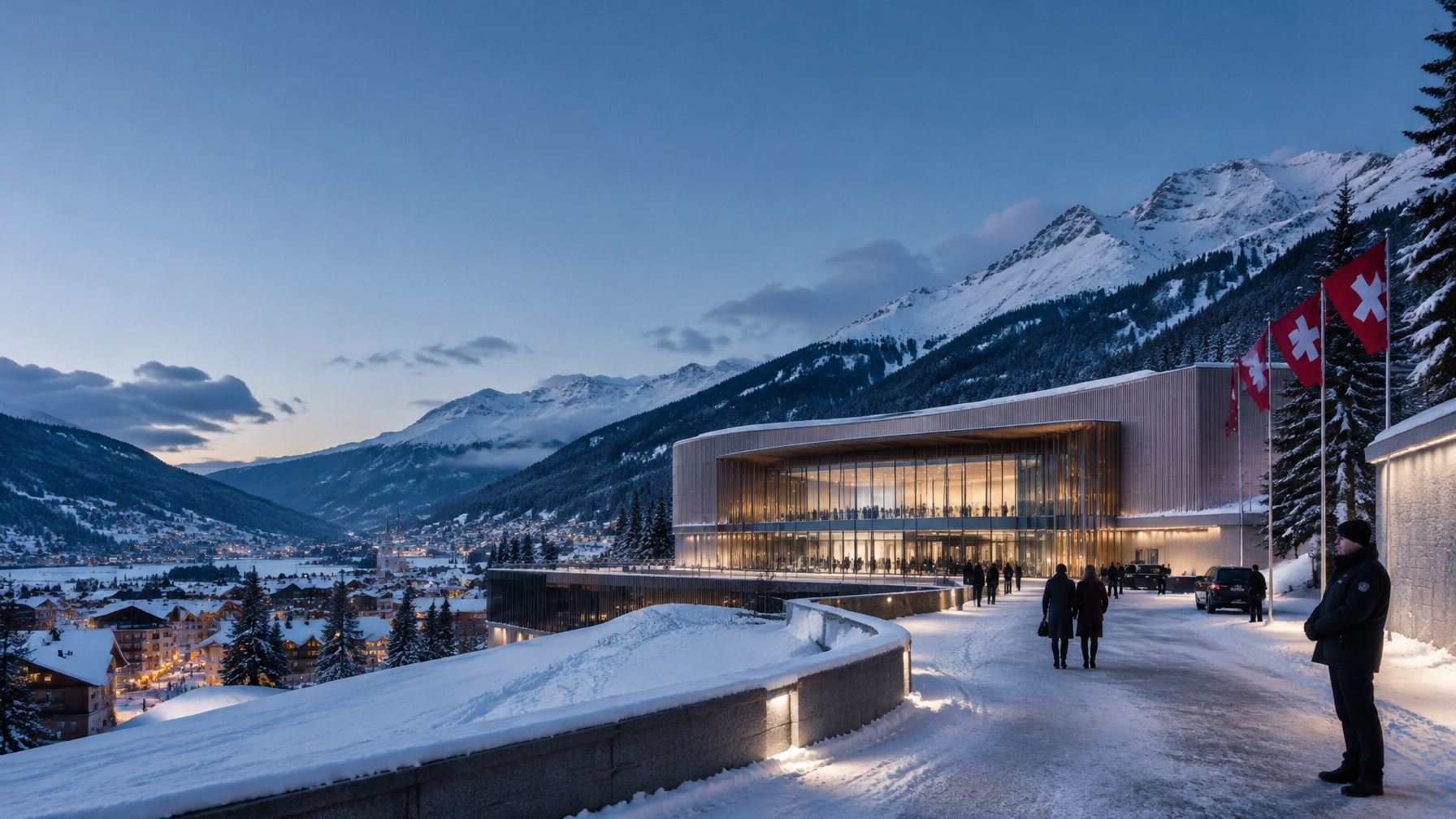
Defence at Davos 2027: The Quiet Rooms Where Rearmament Gets Discussed
By The Davos Collective · 24 October 2026 · 7 min read

The defence conversation in Davos week 2027 is taking shape in private investment rooms, invitation-only convenings and one national house. The public programme remains thin; the capital and industrial agenda does not.
The January 2027 defence map
The World Economic Forum Annual Meeting runs Monday 18 to Friday 22 January 2027 in Davos. Defence-related activity is spread across the week, with one AI summit taking place beforehand. These are independent gatherings, not sessions of the official WEF programme.
Event Confirmed details Access and focus
Davos Catalyst 12–15 January, Davos Event Lounge, Rätia Center, Promenade 40 Invitation or application; no open ticket sale. Four themes include sovereign and defence AI.
Cyber Future Dialogue 19–20 January, Schatzalp Hosted by Cyber Future Foundation; curated leadership convening on security, technology and prosperity.
Cyprus Valley Davos Deal Room 19–20 January, central Davos; hotel name pending Invitation-only, eight-seat delegation. Includes a closed Defence Dinner and defence/dual-use panels.
Italian House Davos (Casa Italia) Thursday 21 January, 09:00–22:30, Oberestrasse 33 First edition. Defence Technologies & Space Economy sector, including a Defense-Tech forum from 10:45–11:30.
House of Romania 2027 date and venue not announced Invitation-only day of panels and closed-door sessions on security, energy, technology and regional connectivity.
The Davos 2027 side-event directory currently shows two of 65 publicly listed events tagged Defence & Security. Across all topics, 27 events have host-confirmed dates; most programmes publish between November and January. The same directory mapped 497 side events in 2026. This is an early snapshot, not a complete map of Davos defence events 2027.
Why defence stays off the main stage
Davos is not a defence trade show. Its purpose is not to display equipment or publish procurement specifications. The defence conversation instead intersects with the week’s investment, technology and government networks: who can build capacity, who can finance it, what supply chains are viable, and how dual-use technologies move from research into deployment.
That favours smaller rooms. Closed dinners and curated meetings allow participants to discuss commercial relationships and strategic priorities without turning every exchange into a public announcement. A national house can offer a more visible platform, but the conversations around investment, partnerships and procurement remain selective.
The distinction matters: public discussion of defence may appear on official stages, while the smaller side events focus on connections and practical follow-through. The 2027 calendar also remains incomplete. A sparse public listing does not mean a sparse week.
The spending behind the invitations
European rearmament is bringing defence industry and capital into sharper focus. The European Defence Agency reports that EU defence expenditure reached €418 billion in 2025, with projections of €454 billion in 2026 and as much as €547 billion by 2029 if current trends continue. Those future figures are projections, not guaranteed spending totals. (EDA, July 2026)
NATO reports that European Allies and Canada increased defence expenditure by more than US$90 billion in 2025, a rise of nearly 20% in real terms. Allies have also committed to investing 5% of GDP annually by 2035: at least 3.5% for core defence requirements and up to 1.5% for broader defence- and security-related investment. (NATO’s 5% commitment)
Several EU instruments add to the investment landscape:
- SAFE: up to €150 billion in loans to support defence investment, principally through joint procurement.
- European Defence Fund: approximately €8.8 billion for 2021–2027.
- EDIP: €1.5 billion in grants for the 2025–2027 programme period.
These mechanisms differ in form and purpose: loans are not grants, and EU-level instruments sit alongside national budgets. Together, they help explain why Davos investors 2027 may be assessing industrial capacity, procurement pathways and dual-use technology, not simply listening to speeches.

The Deal Room: defence beside investment
The Cyprus Valley Davos Deal Room is a compact example of how the rearmament conversation enters the week through investment networks. Its 19–20 January programme brings together family offices, institutional investors and other participants for an investment summit, investor speed dating and a closed Defence Dinner on 19 January. The second day includes longevity and defence/dual-use panels and a sovereign wealth session.
The organiser describes the delegation as eight seats, with meetings matched in advance. Published seat prices are €7,000 for an Observer, €10,000 for a Delegate, including the Defence Dinner, and €15,000 for a Principal. The venue is listed as a four-star conference hotel in central Davos; its name is to be announced closer to the event.
This is a private investment summit held during WEF week, not a WEF event. For participants tracking Davos deal opportunities, its format signals a focus on introductions and allocation conversations. It does not establish that any investment, contract or transaction will result.
Sovereign and defence AI before WEF week
Davos Catalyst takes place from 12–15 January, before the Annual Meeting. The private summit is capped at up to 200 participants and is organised by LDS Switzerland AG. Its four themes include sovereign and defence AI, alongside AI infrastructure, enterprise AI, and AI and capital.
The theme reaches beyond military software. Sovereign AI concerns control across compute, data, models and the systems that support essential services. In defence, that raises questions about reliable systems, data governance and dependence on external providers. Confirmed speakers include Ulrich Ahle of Gaia-X, David Shrier of Imperial College London and Alexandra Beckstein of QAI Ventures. Participation is by invitation or application, with no ticket sale. (Davos Catalyst facts and media information)
Casa Italia’s defence-tech forum
Italian House Davos, also known as Casa Italia, will hold its first Italian Day on 21 January at Oberestrasse 33, between Mountain Plaza Hotel and the Promenade. The day’s programme places defence alongside other strategic sectors, under the heading Defence Technologies & Space Economy.
Its dedicated forum, “Aerospace & defence technologies: engineering, security & advanced manufacturing,” is scheduled for 10:45–11:30. Registration of interest is available through the Italian House Davos programme; the gala dinner is invitation-only. The event is delivered by the Italian House Davos association, a Swiss non-profit chaired by Prof. Brunello Rosa.
Working the quiet rooms
A practical plan for Davos defence side events should start with the host’s own information, not assumptions about access.
- Separate confirmed details from pending ones. Check each event’s date, venue, programme and access route with its organiser. House of Romania, for example, has not announced its date or venue.
- Treat invitations as event-specific. A WEF badge does not automatically provide entry to independently hosted dinners, houses or summits; registration or an invitation does not guarantee admission either.
- Define the purpose of each meeting. Investment, technology partnerships, industrial capacity and policy dialogue require different participants and preparation.
- Check costs and terms early. Davos event registration can involve an application, paid seat or invitation-only process. Confirm current rates, cancellation terms and what each package includes.
- Plan for location and timing. Davos accommodation and venues fill quickly. Map travel between the Promenade, central hotels and Schatzalp before committing to overlapping meetings.
The Davos Collective’s Davos 2027 events calendar and houses overview provide wider planning context as programmes develop.
What remains unconfirmed
The public defence listing is only one part of the picture. The House of Romania date and venue are pending; Cyprus Valley has not named its hotel; and Casa Italia describes its agenda as subject to change. Further Davos houses 2027 and private gatherings may announce programmes in the months ahead.
There is no public, consolidated Davos attendee list 2027 at this point. Searching “Who is attending Davos 2027” cannot yet produce a complete verified roster, and announced speakers are not equivalent to a full participant list. A specific India delegation Davos 2027, or any other national delegation’s attendance, should be verified through official or host announcements rather than inferred from past years.
Frequently asked questions
What are the main Davos defence events 2027?
The clearest confirmed events include Cyber Future Dialogue, the Cyprus Valley Davos Deal Room and Casa Italia’s Defense-Tech forum. Davos Catalyst, held the week before the Annual Meeting, includes a sovereign and defence AI theme.
How can someone attend Davos without a WEF badge?
Some independent side events run their own application, registration or invitation process, separate from WEF accreditation. Check each organiser’s access rules; entry is not automatic.
Are World Economic Forum 2027 events the same as Davos side events?
No. The WEF Annual Meeting and its official programme are distinct from independently hosted Davos side events, dinners and houses. The dates may overlap, but the organisers and entry requirements differ.
When are the WEF 2027 dates, and how should visitors plan?
The Annual Meeting is scheduled for 18–22 January 2027. Confirm each event’s date and location with its host, then coordinate travel, lodging and meeting times.
A developing map
Defence at Davos in 2027 is best understood as a set of focused rooms around a larger economic and political week: investment meetings, technology discussions, private dinners and a national forum. The visible programme is still developing, while confirmed spending trajectories give the conversations their industrial and financial context.
The Davos Collective provides independent intelligence on this ecosystem and is not affiliated with the World Economic Forum.